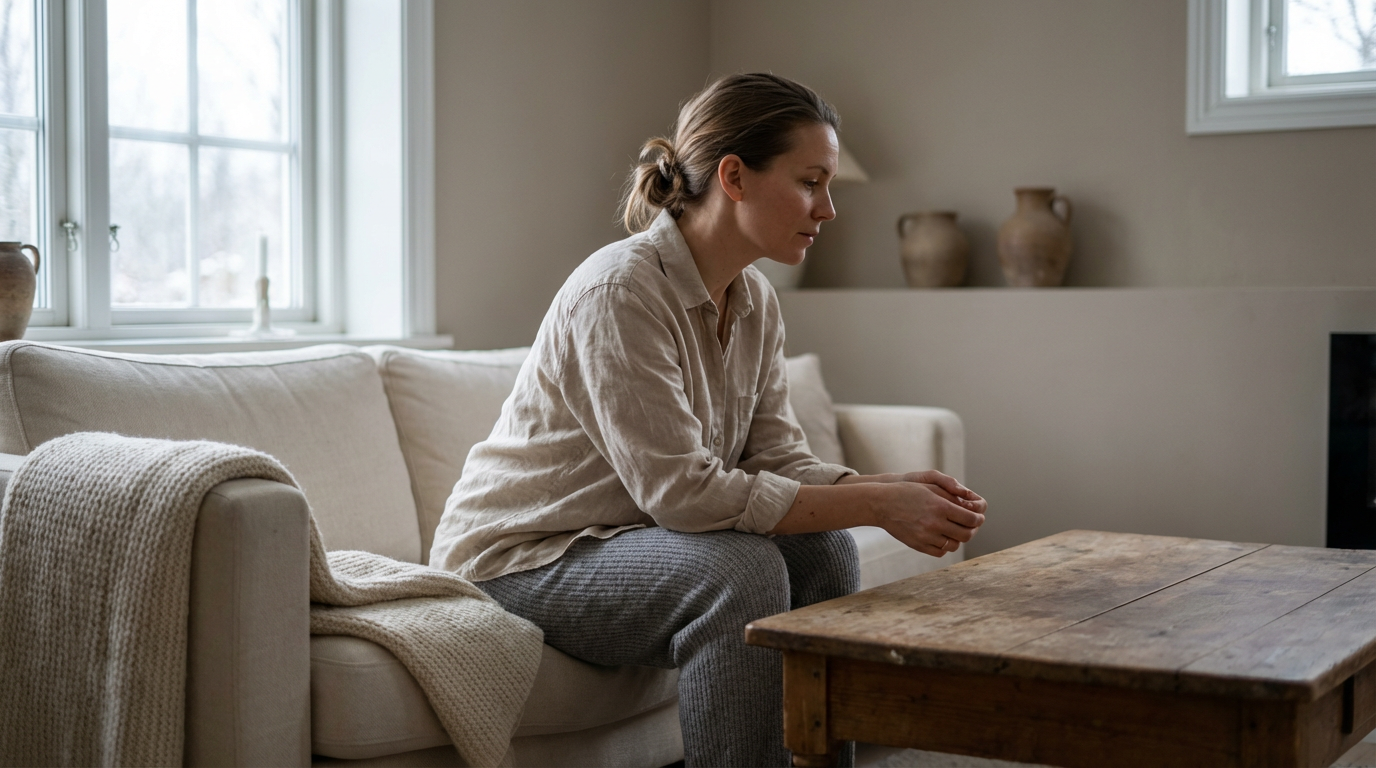
If you’ve ever finally sat down after a long day, only to feel your chest tighten, your thoughts race, or a strange urge to get back up and “do something,” you’re not alone.
I hear this from women every single week.
“I don’t know why, but I feel uneasy when resting.”
“I finally have time to relax, and I can’t.”
“Why resting makes me anxious doesn’t make sense to me.”
And for a long time, I felt it too.
This isn’t laziness.
It’s not a lack of gratitude.
It’s not a mindset problem.
It’s a body that learned, over time, that stillness was not safe.
I work with women who are often seen as capable, dependable, and “having it together,” yet internally feel tense, overstimulated, or constantly on edge. Many are mothers. Many are caretakers. Many have spent years being the reliable one, the steady one, the person others lean on.
So when they finally stop moving, their body doesn’t sigh in relief.
It panics.
If you’ve ever wondered why can’t I relax even when nothing is urgent, this conversation matters.
And it’s long overdue.
We are taught that rest is something you earn.
After the work is done.
After everyone else is taken care of.
After you’ve been productive enough.
For many women, especially mothers, rest comes with unspoken rules. Over time, those rules stop being conscious thoughts and start shaping how the body responds to stillness.
So when you finally pause, your body doesn’t read it as relief. It reads it as danger.
That’s often why resting makes you anxious.
Your system has learned that movement equals safety and stillness equals risk.
A regulated body can move between action and rest without alarm.
A stressed body cannot.
If you’ve been living in high alert for years, slowing down feels unfamiliar. And unfamiliar feels unsafe.
That’s why you might notice:
This feeling uneasy when resting is not a character flaw. It’s a stress pattern.
I talk more about this disconnect between body and demand in When Your Body Says Slow Down and Your Life Says You Can’t, because for many women, the body signals fatigue long before it’s acknowledged. When those early signals are ignored for too long, the body finds louder ways to get attention.
This is one of the most common questions I get.
And the answer is simple, but not easy.
You can’t relax because your nervous system hasn’t learned how to feel safe in rest.
Chronic stress trains your body to stay alert. It learns to scan for what’s next. It learns that rest equals vulnerability.
This happens slowly. Quietly. Over time.
Especially if you:
Your body adapted to survive. That adaptation just hasn’t caught up to the present.
I wrote about this survival conditioning more deeply in Unlearning Survival: How I Stopped Earning My Right to Exist. It was a turning point for me, both personally and professionally.
It’s about identity.
If you’ve built your sense of worth on being useful, needed, or productive, rest threatens that identity.
When you stop, the noise rises.
Thoughts like:
This is why self-love conversations often feel uncomfortable at first. I talk about that more honestly in Self Love, because learning to sit with yourself without proving anything can feel foreign.
Rest strips away distraction. And that can feel confronting.
Motherhood intensifies this pattern.
There is a specific kind of guilt that shows up when mothers rest. A quiet belief that your needs come last. That if you’re not actively giving, you’re taking something away.
This is why so many moms tell me they feel uneasy when resting, even when their kids are asleep or cared for.
I wrote about this tension openly in Love, Guilt, and Isolation: The Taboo Side of Being a Mom and in Mom Confessions, because these feelings are common but rarely spoken out loud.
Silence keeps women stuck.
Conversation creates relief.
From a physiological perspective, chronic stress keeps the body in a heightened state of alert.
When cortisol stays elevated for long periods, the nervous system becomes less flexible. The body struggles to shift into rest mode.
Institutions like the Cleveland Clinic and Harvard Health Publishing explain how prolonged stress impacts relaxation and recovery.
This isn’t about fixing yourself. It’s about retraining safety.
Many women try to “fix” rest anxiety by forcing calm.
Meditate harder.
Lie still longer.
Tell yourself to relax.
That usually makes it worse.
A nervous system that feels unsafe does not respond to pressure. It responds to permission.
This is why gentle regulation works better than rigid routines.
Movement before stillness.
Breath before silence.
Choice before expectation.
My work is not about pushing rest.
It’s about restoring trust between your body and stillness.
Through my wellness work for women, courses, and one-on-one support, I help women:
You can explore my courses or deeper mentorship through Uncensored Beyond if this resonates.
This work is slow. Intentional. Human.
If you’ve been asking yourself why can’t I relax or why resting makes me anxious, I want you to hear this clearly:
Nothing is wrong with you.
Your body adapted to protect you.
Now it just needs help learning that it’s safe to pause.
That process doesn’t start with discipline.
It starts with honesty.
You don’t need to overhaul your life.
Start with:
If you want to learn more about how I approach this work, you can meet me here or explore resources on sandrinelavoiefilion.com.
You’re not behind.
You’re not broken.
And you’re not alone in this.
Feeling uneasy when resting is your body asking for reassurance, not discipline.
The goal isn’t to force calm.
It’s to create safety.
And that is something we can rebuild, together, one honest pause at a time.
If this piece spoke to you, share it. These conversations matter more than we admit.
No spam. Just real support to help you heal, reset, and feel like yourself again.