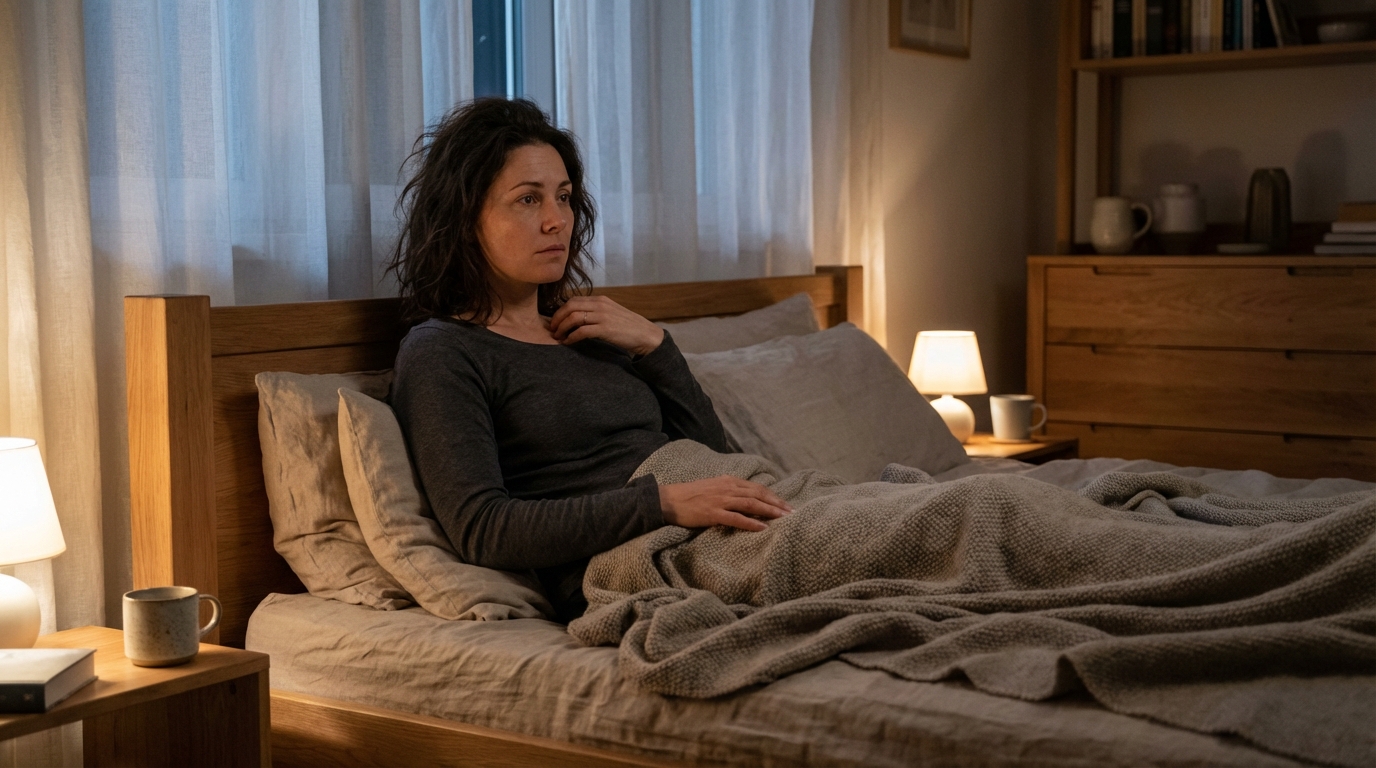
If you’re reading this in the dark, while your thoughts run laps around your mind, I want you to know something first.
You’re not broken.
And this isn’t a willpower issue.
Rest feels hard right now, and that doesn’t mean you’re doing anything wrong.
I talk to women every day who tell me the same thing in different words:
“I’m exhausted, but my brain won’t stop.”
“I lie down and suddenly everything comes up.”
“I feel anxious at night for no reason.”
And for a long time, this was me too.
Nighttime has a way of exposing what we’ve been holding in all day. When the noise quiets, the body finally has space to speak. For many women, especially mothers, that space doesn’t feel peaceful. It feels overwhelming.
This is why so many of us search for how to stop racing thoughts at bedtime and end up feeling even more frustrated when the suggestions we try don’t actually change how our body feels.
During the day, we’re moving. Thinking. Responding. Managing. Carrying.
At night, all of that stops.
When it does, the nervous system doesn’t always follow.
If you feel anxious at night for no reason, it’s often because your body hasn’t had a chance to process the day. The quiet feels unfamiliar. Stillness removes distraction, and suddenly, your thoughts rush in to fill the space.
This isn’t random. It’s a predictable response to prolonged mental and emotional effort.
Your brain isn’t choosing nighttime to be difficult.
More often, it’s responding to the fact that the busyness of the day has finally stopped.
All day long, many women stay in task mode. You respond to needs. You solve problems. You move through responsibility without pausing. Your body stays alert because it has to.
So when you lie down, your system doesn’t switch off. It switches gears.
The thoughts you didn’t have time for earlier finally show up.
This is one of the reasons attempts to “clear your mind” often don’t work. Your mind isn’t cluttered. It’s catching up after hours of being on.
Racing thoughts at bedtime aren’t about sleep hygiene alone. They’re a stress response.
A stressed nervous system looks for control. It scans. It reviews. It replays.
Thoughts like:
These aren’t meaningless loops. They’re the body’s attempt to stay ahead of perceived threat.
If this sounds familiar, you might also recognize yourself in When Your Body Says Slow Down and Your Life Says You Can’t. Many women push through exhaustion until the only place their body can speak is at night.
Motherhood adds another layer.
The mental load doesn’t clock out. Even when the house is quiet, the responsibility lingers. Planning. Remembering. Anticipating.
This is why nighttime anxiety shows up so strongly for moms. The body finally pauses, but the mind is still holding everyone else.
I’ve written honestly about this tension in Mom Confessions and Love, Guilt, and Isolation: The Taboo Side of Being a Mom, because these experiences are common, yet rarely named.
Silence around them only deepens the cycle.
Here’s the hard truth many women need to hear.
There is a reason.
It just isn’t always obvious.
Nighttime anxiety often builds when:
When the body has learned to stay alert, quiet can feel threatening.
This is similar to what I explored in Unlearning Survival: How I Stopped Earning My Right to Exist. Survival patterns don’t disappear just because life slows down. They soften when safety becomes consistent.
One of the biggest mistakes I see is trying to overpower the mind.
Lying in bed telling yourself to relax.
Counting breaths while feeling more tense.
Getting frustrated when nothing works.
That pressure adds fuel.
The goal is not to silence your thoughts. It’s to help your body feel settled enough that your thoughts don’t need to shout.
When women ask me how to stop racing thoughts at bedtime, I don’t start with techniques.
I start with context.
Before your body can rest, it needs:
This is why gentle routines, emotional honesty, and regulation matter more than rigid rules.
Research from sources like Harvard Health Publishing and The National Sleep Foundation supports this. Stress and nighttime anxiety are closely tied to nervous system activation, not just sleep habits.
This is not about doing more. It’s about doing less, differently.
Many women don’t trust their body anymore.
They’ve pushed past signals for years. Ignored fatigue. Minimized overwhelm.
So when the body speaks at night, it feels intrusive.
This is where self-love becomes practical, not performative. I wrote about this shift in Self Love, because learning to listen without judgment changes everything.
Instead of trying to shut your brain down, try meeting it where it is.
Things that often help:
Notice what happens when you stop fighting the experience.
My work through wellness for women, my courses, and Uncensored Beyond is built around one idea.
Your body isn’t working against you. It’s communicating.
When women learn how to listen to those signals with less judgment and more curiosity, meaningful changes follow. Sleep becomes easier to access. Energy steadies. Confidence rebuilds over time through consistency rather than force.
If night is the only time you’re alone with yourself, of course it feels intense.
That doesn’t mean your body is doing something wrong.
It means your system has been busy all day.
You don’t need to force calm.
You need consistency and compassion.
If this article feels like it’s describing you, I want you to know I see you.
Not as someone who needs fixing.
But as someone whose body has carried a lot.
You can learn more about my work and my story on sandrinelavoiefilion.com or meet me here.
If your brain won’t shut off at night, it’s not because your body can’t rest.
It’s because your body has been holding more than it has had space to release, and that can change.
Not by force or by pressure, but by learning to feel safe again in stillness.
If this resonated, share it with someone who lies awake wondering why their mind won’t rest. These conversations matter, and you’re not alone in them.
No spam. Just real support to help you heal, reset, and feel like yourself again.